

TL;DR:
- A structured plan is essential for catering events to run smoothly.
- Digital tools significantly boost efficiency, flexibility, and error prevention.
- Flexibility and reflection matter just as much as checklists for a successful event.
You're coordinating a 300-guest company anniversary, a wedding inquiry just came in, and your head chef needs the final menu sign-off. Moments like these are exactly when a structured checklist decides whether everything runs smoothly or important details slip through the cracks. Catering events are complex: suppliers, staff, menus, guests, and venues all have to align perfectly. Work without a clear plan and you risk costly mistakes and unhappy clients. This article gives you a practical, step-by-step structure to confidently master every planning phase.
Table of Contents
- Basics: Early Planning and Setting Goals
- Detailed Planning: Menu, Service, and Organizational Details
- Final Preparations: Timeline, Emergencies, and Organization
- Digital Checklists vs. Traditional Organization: An Efficiency Comparison
- Why Rigid Checklists Aren't Enough — What Successful Caterers Do Differently
- Discover Smart Solutions for Event Planning
- Frequently Asked Questions
Key Takeaways
| Item | Details |
|---|---|
| Early planning | 3-6 months of lead time are essential for a smooth process. |
| Tailored menu design | Flexible, allergy-conscious menus prevent problems on event day. |
| Use digital checklists | Modern tools save time and prevent errors in the planning process. |
| Emergency preparedness | A backup plan and clear responsibilities safeguard the event's success. |
Basics: Early Planning and Setting Goals
Now that it's clear why structured planning is essential in catering, let's look at the first fundamental steps. If you think you can start organizing three weeks before the event, you're vastly underestimating the effort involved. The planning foundation for catering events starts as early as 3 to 6 months in advance with goal-setting, budgeting, the guest list, and evaluating potential caterers. That may sound like a lot, but it's the only way to spot supplier bottlenecks, staffing shortages, or venue issues early enough to act.
The first step is clearly defining the event. Is it a formal business dinner, a relaxed summer party, or a multi-day conference with breakout catering? The desired image and style of the event shape every decision that follows, from the menu to the table decor. Without this foundation, every team member ends up pulling in a different direction.
Next comes budget planning. It's always worth building in a buffer of at least 10 to 15 percent for unforeseen expenses. Food prices fluctuate, suppliers raise their rates, and sometimes you need extra service staff at short notice. Skip that buffer, and you'll quickly find yourself under pressure.
In parallel, you draft a rough guest list. It's essential for calculating realistic quantities: how many starters, main courses, and desserts will you need? How many drinks per person? These numbers affect not just purchasing, but also staffing and choice of kitchen equipment.
The following checklist covers the key tasks in this early phase:
- Define the event's type and style (corporate event, wedding, trade show, private party)
- Calculate a realistic budget, including a buffer for unforeseen costs
- Create a rough guest list and derive quantities for food, drinks, and equipment
- Put venue and catering requirements in writing
- Request quotes from at least three caterers, compare offers, and check references
When choosing a caterer, it pays to look beyond price. Experience with similar event sizes, flexibility with special requests, and the quality of communication are often more important than the lowest quote. A comprehensive catering checklist helps you compare all these criteria systematically.
Pro tip: Create a standardized request template for potential caterers. It saves you time, gets you comparable quotes, and makes you look professional to vendors.
Detailed Planning: Menu, Service, and Organizational Details
Once the groundwork is laid in the early planning phase, it's time for the details: menu and service take center stage. Detailed catering planning covers things like finalizing the menu, accounting for dietary needs and allergies, defining the scope of service, and finally booking the venue and caterer — ideally 1 to 3 months before the event.
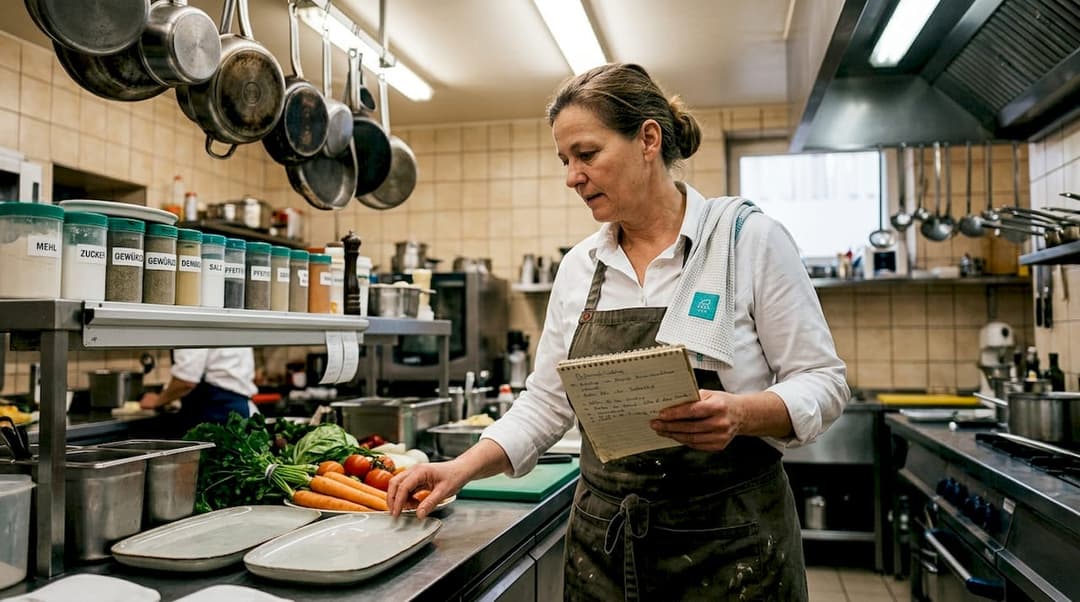
Menu development is more than just picking dishes. You need to systematically track allergies, intolerances, and dietary preferences. Vegan, vegetarian, gluten-free, or halal options are in demand at almost every event these days. Find out about them only on event day, and you have a real problem on your hands. That's why collecting this information belongs firmly in your invitation communications.
At the same time, you decide on the scope of service. Should it be a self-serve buffet, a multi-course dinner with wait staff, or a flying buffet with canapés? Each option comes with different requirements for staffing, equipment, and scheduling. A full-service dinner for 200 guests requires far more coordination than a standing reception.
The key tasks in detailed planning at a glance:
- Finalize the menu and get written confirmation
- Systematically record all guests' dietary needs and allergies
- Define the service concept: buffet, full service, finger food, or a combination
- Officially book the venue and clarify tech, power, and water hookups
- Plan the drinks list and quantities (alcoholic, non-alcoholic, hot beverages)
- Order or rent equipment and furniture (tables, chairs, tableware, decor)
- Finalize supplier contracts and confirm delivery times
- Send regular status updates to the client
Communication with the client is often underestimated in this phase. Sharing clear status updates builds trust and prevents misunderstandings right before the event. Good kitchen organization is just as crucial here as external communication.
Pro tip: Use digital forms to collect allergy and dietary information. That way, all the data lands automatically in your system, and you avoid transcription errors from handwritten notes.
For efficient catering workflows, it's also essential that every booking and agreement is documented in writing. Verbal promises are not a solid foundation in the event business.
Final Preparations: Timeline, Emergencies, and Organization
Once every detail is locked in, the focus shifts to the final touches and making sure everything runs safely. In the 2 to 4 weeks before the event, the timeline, decor, responsibilities, and final agreements are what prevent mishaps on the day itself.
The timeline is the heart of this phase. It sets, down to the minute, when the team sets up, when service begins, when breaks happen, and when teardown starts. Without it, every team member acts on their own judgment — a recipe for chaos, especially when several vendors are on site at once.
The final weeks before the event follow this structure:
- Create a detailed timeline with times for setup, service, breaks, and teardown
- Brief the team and assign clear tasks to each person
- Designate points of contact for vendors, the client, and internal communication
- Set up a contingency plan for scenarios like staff shortages, technical issues, or bad weather
- Prepare decor and materials and pack them ready for transport
- Run final checks: quantities, allergen lists, equipment, contact details
"A good contingency plan isn't a sign of pessimism — it's a sign of professionalism."
The contingency plan in particular is often neglected. What happens if two service staff call in sick at short notice? Is there a backup list of available temp staff? What do you do if a supplier doesn't deliver on time? Thinking through these scenarios in advance keeps you calm and capable of acting on the day. Real-world examples from catering operations show how experienced teams handle situations like these.
Pro tip: Set up a digital communication channel (like a messaging group) for the entire event team. That way, urgent information reaches everyone instantly, without a chain of phone calls.
Digital Checklists vs. Traditional Organization: An Efficiency Comparison
After the classic workflow structure, the question becomes: how do you make the whole thing efficient, modern, and low on errors? The answer lies in comparing traditional methods with digital tools. Digitalization and automation open up new possibilities for efficiency, interactivity, and error prevention in catering — especially compared to spreadsheets and paper forms.
| Criterion | Traditional (Paper/Excel) | Digital (Software) |
|---|---|---|
| Up-to-dateness | Manual updates required | Real-time sync |
| Error rate | High (transcription errors) | Low (automated processes) |
| Mobility | Limited | Available anywhere |
| Team communication | Slow, error-prone | Direct and transparent |
| Adaptability | Labor-intensive | Fast and flexible |
| Sustainability | High paper use | Can go paperless |
The weaknesses of traditional methods show up especially in stressful situations. A spreadsheet edited by three people at once almost inevitably leads to version conflicts. Paper lists get lost or become illegible. Anyone who makes a change has to manually inform everyone else involved.
Digital tools solve these problems structurally:
- Automatic notifications when the menu, guest count, or schedule changes
- Mobile access for the whole team, even in the kitchen or during setup
- Interactive menus guests can select directly via an app
- Sustainability features: automatically adjust quantities and reduce food waste
- Integrated communication with suppliers, service staff, and clients
Modern software pays off especially for recurring tasks like shopping lists, production plans, or shift scheduling. Catering automation doesn't just save time — it measurably cuts the error rate too. If you're still on the fence, a comparison of digital solutions for event catering offers concrete arguments for making the switch. And if you're ready to take the first step, digitizing your catering business shows you how to get started.
Why Rigid Checklists Aren't Enough — What Successful Caterers Do Differently
Checklists are indispensable. But if you think a perfect list is a cure-all, you're mistaken. The most experienced catering teams we know use checklists as a foundation, not a straitjacket. The key difference lies in mindset: work through a list rigidly, without keeping an eye on the bigger picture, and you'll miss client needs, edge cases, and last-minute changes.
A guest with a rare allergy, a speaker who runs 20 minutes long, a supplier who shows up late. None of that is on any checklist. Successful teams respond with flexibility because they understand the process, not just the boxes to tick. Digital tools support exactly that: they allow spontaneous adjustments in real time and significantly improve team communication through digital processes.
Add to that an open culture around mistakes. Teams that take a moment after every event to reflect on what went well and what didn't keep improving continuously. Short feedback loops are worth more than even the most detailed checklist. The combination of structured planning, digital tools, and genuine willingness to learn is what separates good catering businesses from truly excellent ones.
Discover Smart Solutions for Event Planning
After all this input on checklists and digital organization, it's worth looking at how Univents can support you at every stage of planning.
Univents is the event management software that meets catering businesses and event planning agencies exactly where traditional methods hit their limits. From the first inquiry to the final invoice, Univents centralizes every workflow on a single platform. The built-in event hub for planning and communication keeps your team, suppliers, and clients on the same page at all times. For venues, Univents also offers specialized event venue software that seamlessly connects bookings, resources, and communication. Discover for yourself how much time and hassle the right system can save you. Want a quick head start on your next event? Try our free event checklist tool to build a custom checklist in minutes.
Frequently Asked Questions
What should never be missing from a catering checklist?
The essentials are a clear goal, a realistic budget, the guest list, the menu selection, a detailed timeline, clearly assigned responsibilities, and a solid contingency plan. A catering checklist typically covers the whole arc of an event, from the earliest planning stages through execution and all the way to the post-event wrap-up and debrief.
How early should a catering business start planning?
Starting at least 3 to 6 months before the event is recommended, especially for larger gatherings. Catering fundamentals like budget planning and choosing the right caterer both need plenty of lead time to get right. Rushing these early steps almost always causes avoidable stress and costly last-minute scrambling closer to the event date.
Are digital checklists better than paper and Excel?
Digital tools offer more efficiency, adaptability, and transparency than traditional methods, especially when it comes to team communication. Digital catering solutions deliver real-time updates and measurably cut down on transcription errors. They also make it far easier to keep everyone — from kitchen staff to suppliers — working from the same up-to-date information.
How can food waste and sustainability be factored into catering?
Smart planning focuses on adjustable quantities, sustainable packaging, and deliberately avoiding surplus through precise calculations. Sustainability in event catering is significantly easier to achieve with digital tools than with manual methods, since quantities can be adjusted automatically based on real guest numbers and consumption patterns from past events.
Recommended Reading
- Catering Checklist: Organize Efficiently and Plan with Confidence
- Catering Resource Planning: An Efficient Step-by-Step Workflow
- Planning Catering Resources Efficiently: How the Pros Do It
- Efficient Kitchen Organization for Caterers: A Guide to Optimizing Workflow
- Applying a Checklist for Smooth Hotel Guest Service
See how Univents works specifically for your industry – with all features, examples and pricing at a glance.
Catering Software