

TL;DR:
- Missing menu details and forgotten power sockets are typical symptoms of unstructured event processes. A clear, automated workflow minimises mistakes, saves time and keeps events running smoothly. Automated tools, such as event management software, sustainably improve planning, communication and follow-up.
Missing menu details, a forgotten power socket for the catering station, or a supplier who goes quiet three days before the event. Anyone who has ever coordinated an event professionally has seen it happen. The frustrating part: these mistakes rarely come from carelessness — they come from a process that's too fragmented. If you approach event organisation without clear structure or automated support, you'll spend more time firefighting than actually planning. This article walks you through a practice-tested, step-by-step process that takes you reliably from the first concept through to follow-up.
Table of Contents
- Fundamentals of Event Organisation: What Matters Beforehand
- Step-by-Step Guide: The Event Organisation Process
- Catering and Vendors: How to Plan Without Mistakes
- Attendee Management and Communication: Success Factors at a Glance
- Follow-Up and Error Analysis: Learning for Future Events
- Perspective: Why Automation Is the Game-Changer in Event Organisation
- Efficient Event Organisation with Univents: Your Next Step
- Frequently Asked Questions About Event Organisation
Key Takeaways
| Point | Details |
|---|---|
| Clear step sequence | A structured, step-by-step plan minimises mistakes and stress in event organisation. |
| Become a catering pro | Asking about allergies early and offering a varied vegetarian menu prevents most catering mishaps. |
| Use automated processes | Digital tools and software save time, reduce the error rate and make follow-up easier. |
| Feedback drives growth | Systematic follow-up delivers insights that keep improving every future event. |
Fundamentals of Event Organisation: What Matters Beforehand
Before you make a single call or request a single quote, every event needs a solid foundation. Skip this step and you're building on sand. The good news: answering the right questions early saves you huge amounts of time, money and stress later on.
Defining Goals and Concept as the Foundation
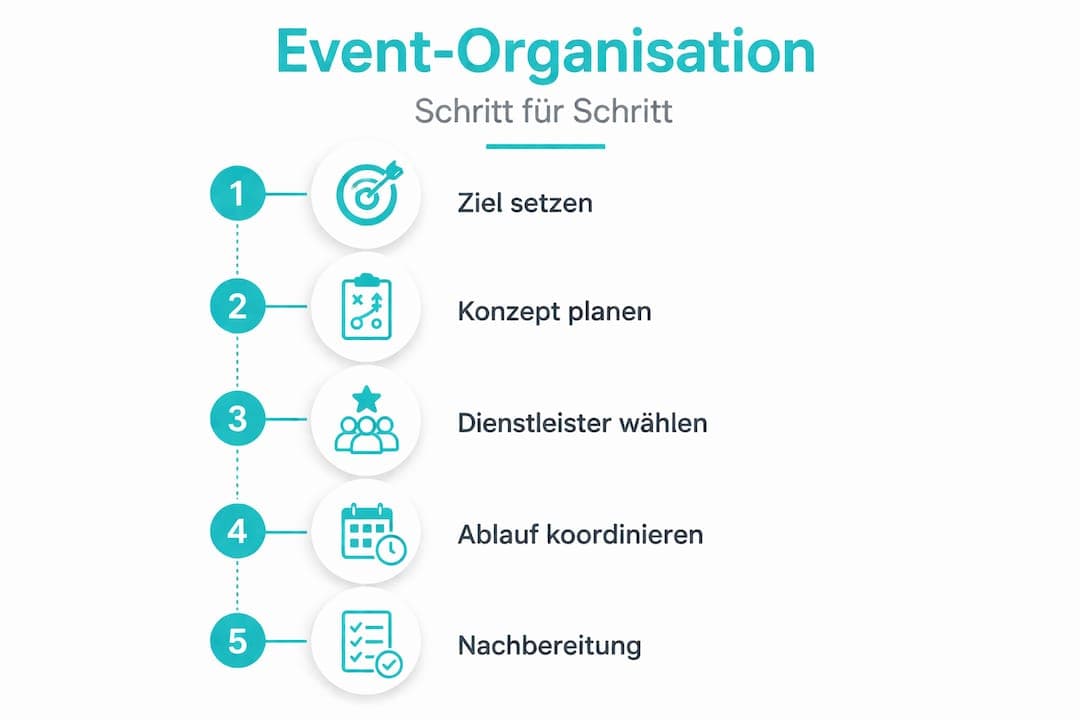
The goal of an event sounds obvious, yet it's surprisingly often left vague. Is it about customer loyalty, revenue, internal team building, or brand presence? The more precise the answer, the easier every decision that follows becomes. Event organisation follows a step-by-step process, from defining the goal through budget and date all the way to follow-up. That framework isn't bureaucratic red tape — it's a safety net.
A concrete concept also answers: What atmosphere should the event create? What does the audience expect? How does the event fit the brand or the occasion? When these answers are documented from the start, everyone involved — from the caterer to the venue manager — can work towards the same goal.
You need to answer these core questions before you start:
- Who is the target audience, and roughly how large will it be?
- What's the concrete budget, including a buffer for the unexpected?
- Which date works for the audience and the market?
- What format should the event take (seated, buffet, walking dinner, hybrid)?
- Who's responsible internally, and who decides what?
For a broader overview of effective event planning, this guide to impactful events shows how even smaller events come across as far more professional with a clear structure.
| Upfront decision | Description | Why it matters |
|---|---|---|
| Goal definition | What should the event achieve? | Drives every other decision |
| Target audience | Who's attending, and what do they expect? | Determines format, catering, communication |
| Budget | Overall budget plus buffer | Avoids nasty surprises at the end |
| Date | Date, time, backup date | Secures availability for everyone involved |
| Format | Seated event, buffet, hybrid | Shapes venue, catering, technical needs |
| Responsibilities | Who decides what | Prevents gaps in ownership within the team |
Pro tip: Start planning at least 8 to 12 weeks before the event. For larger events with more than 100 guests, allow 4 to 6 months. The earlier you book, the more choice you have with venues, caterers and suppliers — and the better the rates usually are.
Step-by-Step Guide: The Event Organisation Process
With the fundamentals in place, it's time to work through the process step by step without missing anything important. A structured workflow gives you confidence while still leaving room for creative decisions.

The Key Steps at a Glance
Typical event processes run through six clearly defined phases. This structure is practice-tested and works for almost any type of event.
- Goal and concept: Define what the event should achieve, what format it takes, and who the audience is. Everything else builds on this.
- Budget and scheduling: Set the financial framework and pick a date that works for your audience, venue and suppliers. Always reserve at least 10 to 15 percent of the budget as a buffer.
- Venue and supplier selection: Visit potential venues in person and check capacity, technical setup and catering options. Get at least three quotes so you can compare prices and services.
- Detailed planning and invitations: Build a minute-by-minute run sheet, send out invitations with clear registration details, and capture special requirements like allergies or dietary needs early.
- Execution: Coordinate everyone involved on the day using a detailed run sheet. Build in buffer time and keep key contacts on hand.
- Follow-up: Collect feedback, review the numbers, and document what you learned for the next event.
The difference between a good event and a great one usually isn't the budget — it's the quality of the preparation. Work through each of these steps carefully, and you'll cut the risk of surprises significantly. Our free event checklist is a good way to keep every phase on track.
Manual Planning vs. Automated Planning
One of the most common pitfalls is sticking with manual processes. Spreadsheets, handwritten lists and undocumented phone calls inevitably lead to lost information. Once you're coordinating several suppliers at once, the complexity quickly becomes unmanageable.
| Criterion | Manual Planning | Automated Planning |
|---|---|---|
| Error rate | High (manual transcription errors) | Significantly reduced |
| Communication | Phone, email, often undocumented | Centralised, traceable |
| Response time | Slow, depends on availability | Instant notifications possible |
| Scalability | Limited, high staffing overhead | Excellent, processes scale with you |
| Data availability | Fragmented across many files | Central and available in real time |
| Time spent | Very high for routine tasks | Greatly reduced through automation |
💡 Studies from the events industry show that companies switching to digital planning tools cut coordination errors by up to 60 percent. That's not a theoretical figure — it's the result of fewer manual handoffs and clear, centralised data.
One particular risk: suppliers who don't respond in time. If you're not tracking communication systematically, you often find out too late that a confirmation is missing. Automated reminders and status tracking solve exactly this problem, without anyone having to chase it up every day.
Catering and Vendors: How to Plan Without Mistakes
Few areas of event planning are more error-prone than catering and vendor management. It's also the area with the biggest impact on attendee satisfaction. Good food, smooth logistics and attentive service stick in people's minds. So does the opposite.
Menu Planning with a System
Catering-specific planning steps start with the basics — date, venue, point of contact — and move through menu planning with an allergy check, all the way to logistics and on-the-day coordination. It's well worth offering 30 to 40 percent of the menu as vegetarian or vegan options. That figure surprises a lot of people, but given changing eating habits and increasingly diverse audiences, it's entirely realistic.
Typical catering edge cases include early allergy checks, accessibility for guests with mobility restrictions, and avoiding long queues by setting up multiple serving stations. Skip planning for these actively, and you'll miss them painfully on the day.
You'll find more examples of well-structured catering quotes for events and a systematic comparison of catering options in specialised resources that help you find the right concept for your event.
Checklist for error-free catering:
- Date, time and location confirmed with the caterer in writing?
- Allergies and intolerances collected from all attendees and passed on?
- At least 30 to 40 percent vegetarian or vegan options planned?
- Power connections and technical requirements clarified with the venue?
- Parking reserved for catering vehicles?
- Equipment such as crockery, cutlery and serving staff fully confirmed?
- Set-up and breakdown times agreed with the caterer?
- On-the-day contact person named and reachable?
- Payment and invoicing clarified?
- Contingency plan in place for supply shortages or staff absences?
For best practices in catering workflows, it's worth relying on proven frameworks that structure exactly these process steps and make them easy to automate.
Pro tip: Clarify every detail with suppliers in writing and document every agreement. A short confirmation email after each call is enough. This documentation protects you in case of a dispute, and makes sure no one on the team misremembers what was agreed.
“The most common mistake in catering planning isn't a lack of knowledge — it's a lack of documentation. Anything that isn't written down might as well not exist on the day.”
Attendee Management and Communication: Success Factors at a Glance
Planning with suppliers and catering is one side of the coin. The other is communicating with attendees themselves. Underestimate this, and you risk no-shows, unhappy guests, and avoidable chaos on the day.
Automated Invitation Systems as a Game-Changer
Manual invitation processes — where replies get collected by email and copied into lists by hand — are error-prone and time-consuming. Automated systems, by contrast, send invitations, collect RSVPs, send reminders and update attendee lists without any manual effort. That doesn't just save time; it cuts human transcription errors to almost zero.
The strategic importance of well-trained venue staff shouldn't be underestimated. The right people in the right place, armed with the right information, are what separates an organised event from one that feels chaotic.
High no-show rates are one of the most avoidable problems with free events. A symbolic ticket price significantly increases commitment to a registration and means far more people who sign up actually turn up. This one simple measure can dramatically improve predictability.
Benefits of automated attendee communication:
- Invitations go out automatically at the optimal time
- Reminder emails cut no-shows without any manual effort
- Allergy and special-requirement questions are built into registration
- Attendee lists stay current and centrally available at all times
- Capacity changes are communicated automatically
- Follow-ups for missing replies run automatically
| Tool / Method | Function | Benefit |
|---|---|---|
| Automated invitation system | Invitation, RSVP, reminders | No manual effort, fewer no-shows |
| Digital registration form | Captures allergies and special requests | Data usable straight away, no transcription errors |
| Real-time attendee list | Current view of registration status | Planning certainty for catering and venue |
| Automatic status notifications | Attendees get updates automatically | Fewer queries, higher satisfaction |
| Waitlist function | Automatic promotion when someone cancels | Maximum attendance without manual effort |
Well-coordinated attendee communication isn't a nice-to-have. It's the foundation that lets catering, seating and staffing work from real numbers on the day, instead of relying on guesswork.
Follow-Up and Error Analysis: Learning for Future Events
The work doesn't end when the last guest leaves. Follow-up is often the most underrated part of the entire event process — yet it's the one step that actually lets you learn and makes every future event systematically better.
Why Structured Feedback Is Worth Its Weight in Gold
A short feedback form sent to all attendees right after the event delivers valuable data. The key is not just capturing general ratings, but asking specific questions: How was the catering? Was the room temperature comfortable? Was the schedule clearly communicated? Specific questions give you specific answers you can actually act on.
What good follow-up should cover:
- Systematic feedback from attendees, suppliers and your internal team
- Comparing actual costs against the planned budget
- Documenting every deviation from the run sheet and its cause
- Rating supplier performance to inform future booking decisions
- Archiving all contracts, invoices and communication in one central place
- Writing a short summary with concrete suggestions for improvement
Digital analysis tools make this process far more efficient. Instead of copying feedback into spreadsheets by hand, data gets aggregated and visualised automatically. Trends become visible: was catering consistently a weak point? Did certain suppliers repeatedly cause communication problems? Patterns like these only emerge from consistent follow-up across multiple events.
Treat follow-up as a tedious obligation, and you miss the chance to learn from real experience. Treat it as a strategic tool, and you build a genuine competitive advantage over time. Every event leaves behind data points that make your next one more precise, more efficient and more professional.
One more often-overlooked aspect: feedback from your own team. The people working the kitchen, the front desk or the technical side on the day see things an event manager overseeing from above simply doesn't. These internal perspectives are at least as valuable as attendee ratings.
Perspective: Why Automation Is the Game-Changer in Event Organisation
After all these methodical steps, we want to say one thing clearly: the biggest challenge in modern event organisation isn't a lack of knowledge. It's sticking with processes that were built for a different era.
The classic paper-and-spreadsheet approach — spreadsheets, email chains, notepads — has hit its ceiling. Not because those tools are inherently bad, but because events have become more complex. Attendee expectations have risen. The number of suppliers you need to coordinate has grown. And the speed at which decisions need to be made leaves little room for manual processes.
Successful events need scalable, automated workflows. That's not an opinion — it's an observation from practice. Companies that switched to digital workflows early report not just fewer mistakes, but calmer teams, happier clients and significantly better scalability. They can run more events at once without hiring proportionally more staff.
But there's a real challenge here too: cultural change within the team. New software alone doesn't solve anything. If the team isn't brought along, you end up with parallel structures where the digital tool and the old paper habits exist side by side. That's worse than having neither. The real investment isn't the software — it's winning the team over and consistently changing habits.
Teams that manage this change well set clear expectations, offer training, and celebrate early wins loudly. One small win — the first fully automated registration confirmation, or the first digitally signed quote — is worth more than any presentation on digital strategy.
Software and digital workflows are no longer optional for modern event management. They're mandatory. Anyone still doubting that today will find, in three years' time, that the market has already made the decision for them.
Efficient Event Organisation with Univents: Your Next Step
Every step, checklist and method in this article works far better in practice when you have one system that brings it all together in a single place.
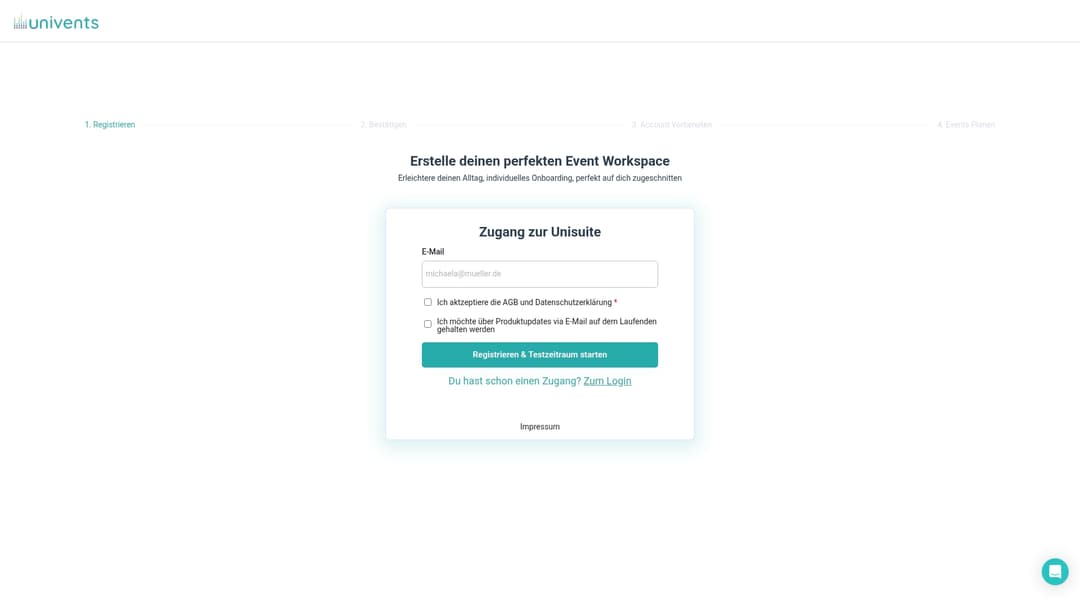
Univents is built exactly for that. As specialised event management software, the platform centralises every operational step, from the first enquiry to the final invoice. You manage quotes, coordinate suppliers, capture attendee data and run catering processes from a single digital workspace. The built-in event hub for event planning means everyone involved always has access to up-to-date information. And with the automated booking system, requests and confirmations get processed without any manual effort. If you're ready to take your processes to the next level, Univents is the logical next step.
Frequently Asked Questions About Event Organisation
Which steps are especially important for successful event planning?
The key phases are defining your goal, budget planning, choosing a venue, sourcing catering, detailed planning, execution and structured follow-up. Working through all six phases consistently significantly reduces the risk of mistakes.
How can you avoid catering mishaps at events?
A detailed checklist with an early allergy check and at least 30 to 40 percent vegetarian menu options lowers the risk of classic catering mishaps. Written confirmation of every agreement is essential.
How can you reduce no-shows at free events?
A reasonable ticket price increases commitment to the registration and noticeably reduces the no-show rate. Automated reminder emails shortly before the event reinforce this effect further.
Which tools support digital event planning?
Digital solutions such as specialised event management software, automated booking tools and integrated communication systems create more oversight, reduce mistakes, and enable scalable planning even as the number of events grows.
Further Reading
- Event Planning Guide: Efficiently to a Successful Event
- Step-by-Step Event Planning: Efficient with Software
- 7 Proven Ways to Increase Efficiency in Event Management
- Mastering Staff Planning Step by Step for Event Professionals
- Glass as an Event Gift: Benefits and Practical Tips – Shotglass24