

TL;DR:
- Hybrid events combine physical presence with virtual participation to give every attendee an equally valuable experience. They require careful technical planning, coordinated programming, and parallel run-of-show plans to keep both groups interactive and engaged. The format extends reach, generates better data, and produces content you can reuse long after the event — but it takes more resources than a pure in-person or online event.
A hybrid event is an event format that combines physical presence and virtual participation so that every attendee, whether on-site or online, gets the same value and an equally good experience. It is not just a livestream of an in-person event. ON24 defines hybrid events as events where both audience groups are actively engaged and get identical ways to interact. In practice, that means someone joining from home experiences the same programme, the same discussions, and the same networking opportunities as someone attending in person. For event planners and companies that want to run hybrid formats, this basic understanding is the essential starting point.
What exactly is a hybrid event?
A hybrid event brings together two experience layers under one shared programme. On-site and remote attendees experience the same event at the same time and can interact with each other, ask questions, and take part in polls. That is what fundamentally sets hybrid events apart from a simple recording or a livestream watched after the fact.
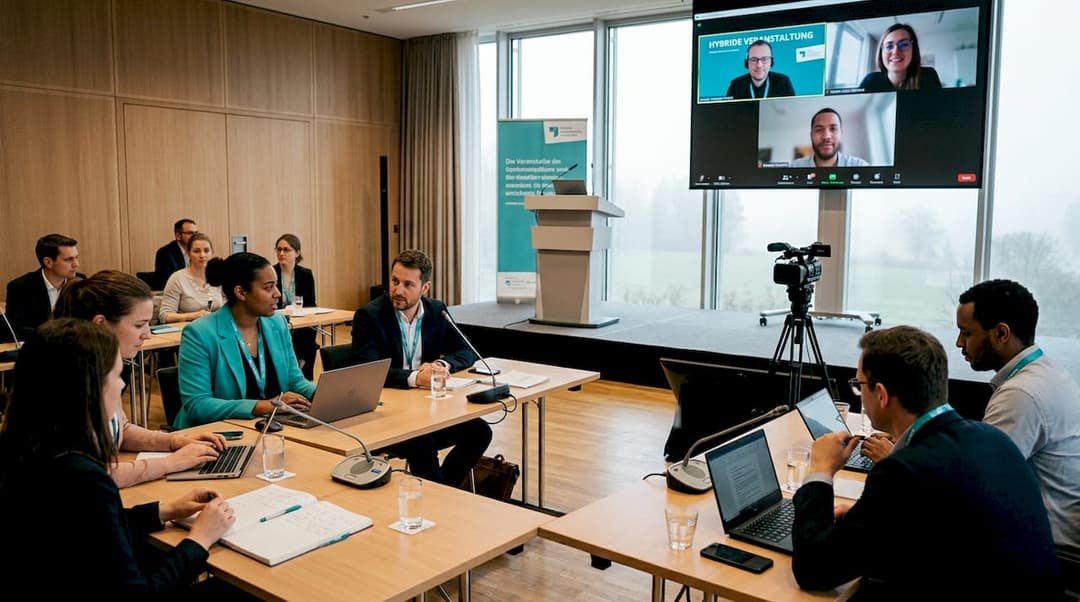
The term "hybrid event" is sometimes used interchangeably with "hybrid meeting" or "hybrid conference," depending on the format. All of these describe the same concept: a synchronous, simultaneous experience for more than one audience segment, in the room and online, at the same time.
What many people underestimate: a hybrid event needs its own programming for the digital audience. ON24 warns explicitly against treating hybrid as just a technical add-on. Online attendees expect an active, interactive experience, not a passive spectator role. Ignore that, and what you get isn't a hybrid event, it's an in-person event with a camera pointed at it.
Typical formats run as hybrid events include corporate conferences, product launches, annual general meetings, training sessions, and trade shows. The range spans everything from small internal team meetings to international conferences with thousands of attendees.
How do hybrid events work, technically and creatively?
Hybrid events place far higher demands on technology and planning than a purely in-person format. Bernstein Agentur points out that audio, video, streaming, and show direction are the core technical building blocks. If these elements aren't coordinated, one of the two audiences ends up with a worse experience.
The key technical building blocks at a glance
- Audio: Room acoustics and microphone setup need to work for both the in-room audience and the broadcast. Bad audio is the number one reason online attendees drop off.
- Video: Multiple camera angles, professional lighting, and stable picture quality are non-negotiable. A single laptop camera feed is not enough for a hybrid format.
- Streaming infrastructure: Platforms like ON24, Zoom Webinars, or Microsoft Teams Live Events carry the broadcast. The platform you choose directly shapes what online attendees can actually do to interact.
- Show direction: A dedicated director coordinates camera cuts, on-screen graphics, and moderation across both channels at the same time.
- Interaction tools: Chat, live polls, Q&A features, and digital networking rooms actively connect both groups with each other.
Programming: the underrated success factor
Technology alone doesn't make a hybrid event. Planning the offline and online programming together is what makes the overall experience feel coherent. Concretely: breaks need to work for both groups. Networking segments need a digital equivalent. Audience contributions from the floor need to be wired up technically so online attendees can actually hear them and respond.
A common mistake is planning the tech without a programming concept for two audiences. The result is an unequal experience, where online attendees feel like second-class spectators. Anyone planning a hybrid event should build two parallel run-of-show plans from the start and keep them in sync.
Pro tip: Schedule at least one full run-through with both attendee groups before the actual event. Technical problems almost always show up when everything runs together, not in isolated tests of individual devices.
What are the benefits of hybrid events for companies?
Hybrid events aren't a compromise between in-person and online, they're a format in their own right, with clear strengths. The main benefits fall into four categories:
-
Greater reach: People who can't or don't want to travel can still take part. That opens the event up to international audiences, people with limited mobility, and attendees with little time to spare. Your potential audience grows without venue costs rising in step.
-
Equal participation: Both groups experience the same programme at the same time and can interact with each other. That creates a shared experience that a pure online event can't offer.
-
Better data and insights: ON24 cites interactive features and usage data as a major benefit of hybrid formats. Chat logs, poll results, click paths, and time-on-content give you insights that a pure in-person event simply can't measure. That data helps you plan future events more precisely.
-
Flexibility and cost savings: Attendees save on travel and accommodation. Companies can put budget to better use because not everyone needs to be housed on-site. At the same time, the value of face-to-face contact is preserved for those who do attend in person.
There's also a strategic advantage that often gets overlooked: recordings of hybrid events can be reused afterwards as on-demand content. A single one-day event generates content that keeps working for weeks or months. That significantly extends your return on investment.
For efficiency in event management, the hybrid format also means resources can be deployed more precisely, because planning, communication, and attendee management all happen digitally.
Hybrid event vs. in-person event: what's the difference?
Many event planners wonder when a hybrid format makes more sense than a pure in-person or pure online event. The table below shows the key differences:
| Feature | In-person event | Hybrid event | Online event |
|---|---|---|---|
| Where you attend | On-site only | On-site and online | Online only |
| Reach | Limited by venue capacity | High, can go global | Very high, global |
| Interaction | Direct, in person | Two-channel, synchronous | Digital, can be asynchronous |
| Technical effort | Medium | High | Medium |
| Cost to attendees | Travel and accommodation | Flexible, attendee's choice | Minimal |
| Data capture | Limited | Extensive | Very extensive |
| Experience quality | High, personal | Equal for both groups | Depends on the platform |
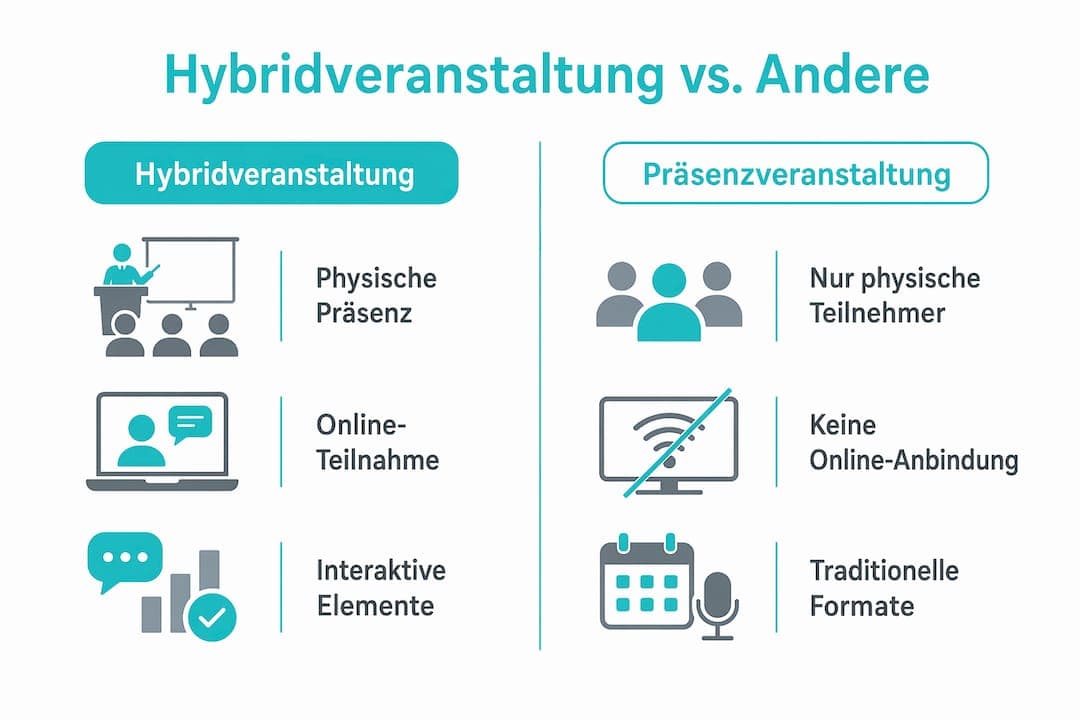
The real difference between a hybrid event and plain streaming comes down to ambition. Streaming means the camera just runs alongside the event. Hybrid means both groups are actively looked after at the same time, with their own moderation, their own interaction moments, and their own technical support. That takes more resources, but it also delivers a much more valuable result.
Hybrid events work especially well for formats where face-to-face contact matters but not everyone can or wants to travel. Annual general meetings, international conferences, and large product launches are typical use cases. A pure online event makes more sense when in-person interaction doesn't matter and maximum scalability is the priority.
If you're looking for the right venue for the in-person part, our overview of event venues is a useful starting point for which spaces are technically suited to hybrid formats.
Hybrid events in 2026: real-world examples and current trends
By 2026, hybrid events are no longer a niche format, they're an established standard in the event industry. One concrete example: the 53rd Austrian Economics Conference ran as a hybrid event, with an in-person audience at the main building of the Austrian National Bank and simultaneous digital participation. High-profile speakers such as IMF chief Kristalina Georgieva took part, and the format delivered international reach that a purely in-person event could never have matched.
The event industry in 2026 is leaning increasingly on the following developments:
- Experience design: The experience comes first, not the technology. Both audience groups should be engaged emotionally and actively involved.
- Micro-events: Instead of one big annual event, companies are running several smaller, topic-focused hybrid formats that are more precisely tailored to specific audiences.
- AI-powered networking: Algorithms suggest relevant people to talk to, both on-site and online. This solves one of the biggest problems in hybrid events: the lack of spontaneous networking for online attendees.
- Audience segmentation: Hybrid events are no longer planned as a one-size-fits-all format, but with different content and interaction paths for different attendee groups.
- Portfolio thinking: Treating hybrid events as part of a deliberate portfolio, rather than a technical add-on, helps give each one clearly defined goals and target audiences.
Pro tip: Don't plan hybrid events as an extension of an existing in-person format, treat them as their own concept. Ask first: what should both groups experience, learn, and take away? Only then: what technology do we need to make that happen?
Combining digitalisation in the event space with strategic planning makes hybrid formats one of the most effective tools in modern corporate communication.
Key takeaways
Hybrid events are their own format, one that only works if technology, programming, and organisation are planned equally for both attendee groups from the very start.
| Point | Details |
|---|---|
| Hybrid event definition | A hybrid event combines in-person and online into one equally valuable, synchronous experience for every attendee. |
| Technology and programming | Audio, video, streaming, and show direction need to work together; a separate run-of-show for online attendees is a must. |
| Benefits for companies | Greater reach, better user data, and reusable content make hybrid events economically attractive. |
| How it differs from other formats | Hybrid isn't streaming. Both groups are actively supported, moderated, and involved interactively. |
| 2026 trends | Experience design, micro-events, AI networking, and portfolio thinking are shaping hybrid event management today. |
My take after years in event planning
Why hybrid is more than a technical upgrade
I've worked on plenty of events where hybrid was treated as an afterthought. Set up a camera, start a stream, done. The result was always the same: online attendees felt like spectators, not participants. Drop-off rates were high, and the feedback was sobering.
What I've learned: hybrid events only work if both experience layers are planned as equals from day one. That means more effort, more coordination, and often a bigger budget. If you're not prepared for that, you're better off going pure online than running a half-hearted hybrid.
But the effort pays off when your audience is genuinely diverse. If part of your audience can't travel, if you need to bring in international expertise, or if reach and data matter strategically, hybrid is the right format, not as a compromise, but as a deliberate choice.
What's pleasantly surprised me about 2026 is that AI-powered networking is starting to solve the biggest problem in hybrid events. The spontaneous encounters that happen naturally in person don't just materialise online. Algorithms that suggest the right people to talk to aren't a gimmick, they're a genuine added value.
My advice: plan hybrid events with the same ambition as an in-person event. Two run-of-show plans, two moderation concepts, two technical support teams. Do that consistently, and you'll deliver a format that genuinely works for everyone.
— Andreas
Plan and run hybrid events with Univents
Hybrid events are complex. They combine physical logistics with digital coordination, and that's exactly where most of the planning effort goes. Univents helps event planners and event businesses manage both layers from one central place.
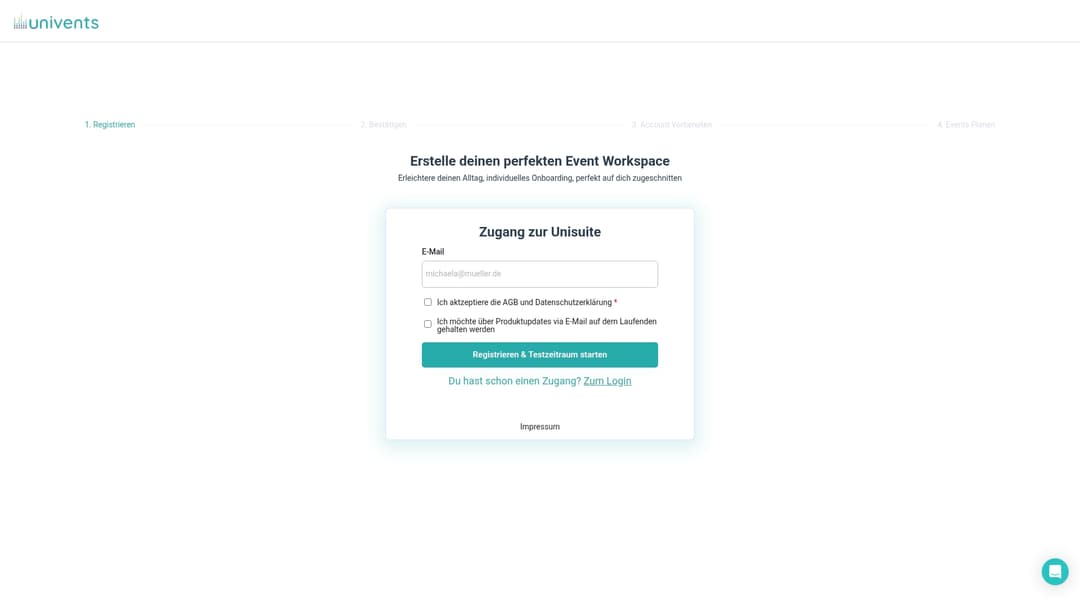
With Univents event management software, you coordinate bookings, quotes, communication, and resource planning on a single platform. Instead of switching between different tools, you have all the information about your event in one place. That saves time, cuts down on errors, and gives you the overview that complex hybrid formats demand. Try Univents and see what event planning feels like when everything works together.
Frequently asked questions
What's the difference between a hybrid event and a livestream?
A hybrid event actively involves online attendees in the programme, with interaction, moderation, and an equally valuable experience. A livestream just broadcasts what's happening on-site, without any dedicated support for the digital audience.
What technology do I need for a hybrid event?
At minimum, you need professional audio and video equipment, a stable streaming platform such as ON24 or Zoom Webinars, dedicated show direction, and interaction tools like chat and live polls. Running a test before the event is non-negotiable.
Which event formats work especially well as hybrid?
Hybrid formats work especially well for conferences, annual general meetings, product launches, and training sessions where part of the audience can't or doesn't want to travel, but face-to-face contact still adds value.
How much more effort is a hybrid event compared to an in-person event?
Hybrid events need considerably more coordination than a purely in-person format, from concept through technology to supporting both groups during the event itself. Budget at least 30 to 50 percent more preparation time.
Can I reuse the recording of a hybrid event afterwards?
Yes. Recordings of hybrid events can be repurposed as on-demand content, for example as training material, for people who missed the live session, or as marketing content. That significantly extends the impact of a single event.
Further reading
- The role of digitalisation in events: boosting efficiency
- What Is Event Software? The Complete Guide
- Event Back Office Defined: A Guide for Organisers
- Event Software Explained: An Efficiency Booster for Event Managers