

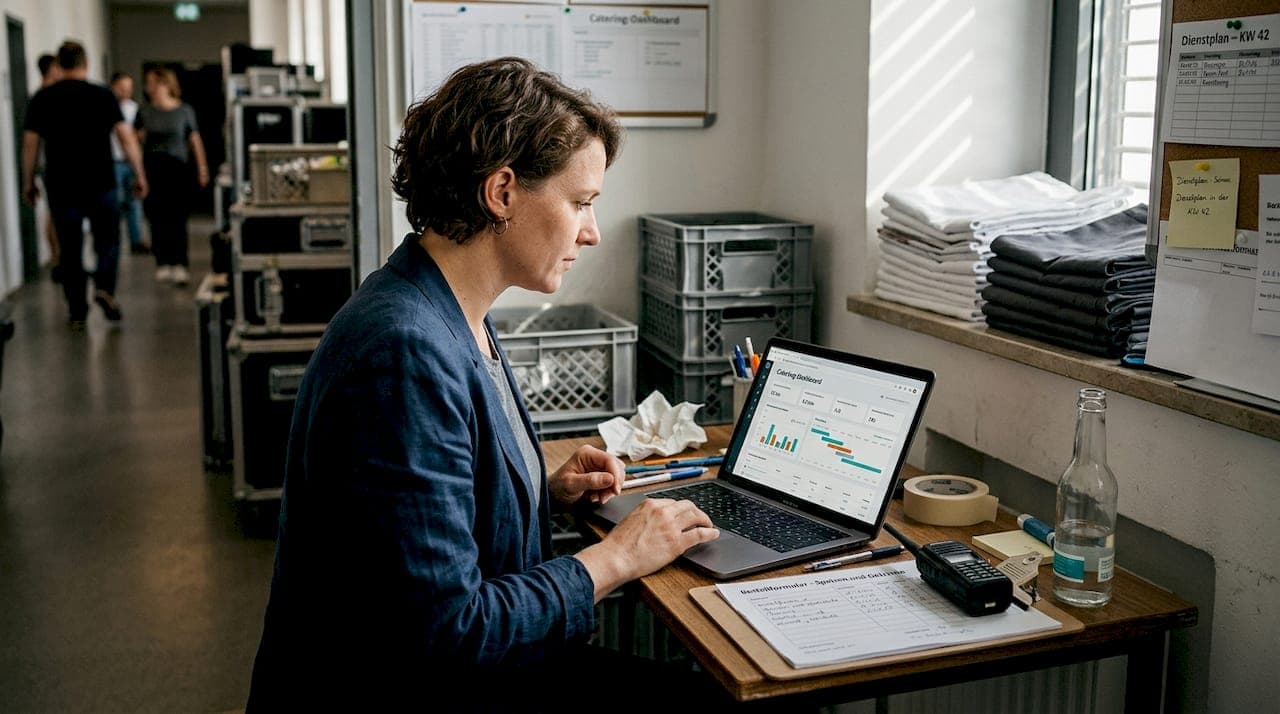
Many people think catering management is just about organizing food and drinks for events. But that falls short. Professional catering management coordinates every process around catering, from menu planning through resource allocation and staff management to logistics and budget control. For event planners and catering companies, efficient catering management is the difference between chaotic operations and smooth-running events. This article shows which tasks belong to catering management, which methods have proven effective, which challenges arise, and how digital solutions boost efficiency.
Table of contents
- Key takeaways
- What does catering management mean and what tasks does it include?
- Methods and best practices for efficient catering operations
- Challenges and edge cases in catering management
- Digitalization and software solutions for optimized catering management
- Using professional event management software from Univents
- What is catering management? FAQ
Key takeaways
| Point | Details |
|---|---|
| Scope of catering | Catering management covers the planning, organization, and control of every catering process, from the menu to budget control. |
| Core catering tasks | Tasks include menu planning, resource allocation, staff management, logistics, budget control, and quality assurance. |
| Five-step process | The process follows needs assessment, resource planning with buffers, logistics coordination, real-time monitoring, and follow-up. |
| Buffers as a safety net | Time and resource buffers guard against fluctuations and prevent bottlenecks. |
| Digital solutions | Digital systems increase transparency and support planning and coordination in real time. |
What does catering management mean and what tasks does it include?
Catering management is the professional planning, organization, and control of every process around catering at events. It goes far beyond simply preparing food and includes strategic and operational tasks that significantly influence the success of every event. Event planners and catering companies need to understand that catering management is a complex system that brings several disciplines together.
The most important tasks in catering management are:
- Menu planning and recipe development based on client preferences, budget, and dietary requirements
- Resource allocation for ingredients, equipment, staff, and transport capacity
- Staff management, including shift scheduling, training, and coordinating kitchen and service teams
- Logistics coordination for deliveries, setup, service, and teardown at the venue
- Budget control and costing to ensure profitability
- Quality assurance and compliance with hygiene standards
The difference between catering management and pure kitchen work lies in the holistic perspective. While chefs focus on preparation, catering management orchestrates every process from the first client contact to the follow-up. A catering manager coordinates teams, negotiates with suppliers, plans buffers for the unexpected, and makes sure everything runs smoothly on the day of the event.
Why is professional management essential? Events are time-critical and prone to error. Without structured management, staffing bottlenecks appear, ingredients arrive late or in the wrong quantities, and quality suffers. Professional catering management minimizes these risks through forward-looking planning and clear processes. Catering management systems digitize these processes and create transparency for everyone involved.
“Successful catering management means holding all the threads in your hands while staying flexible enough to respond to change. It's the art of combining planning with improvisation.”
Methods and best practices for efficient catering operations
Efficient catering management follows proven methods that create structure while still allowing flexibility. The five-step process includes needs assessment, resource planning with buffers, logistics coordination, real-time monitoring, and post-event evaluation. These steps form the backbone of every professional catering management operation.
The structured process looks like this:
- Needs assessment through detailed client conversations about guest count, dietary preferences, budget, and venue specifics
- Resource planning with a 10 to 15 percent buffer on ingredients and staff to guard against fluctuations
- Logistics coordination with a 30 percent time buffer for transport, setup, and unforeseen delays
- Real-time monitoring via software to coordinate kitchen, service, and management during the event
- Post-event evaluation to analyze deviations, costs, and client feedback for continuous improvement
Resource and time buffers aren't waste — they're necessary safety nets. At large events with 200-plus guests, unexpected situations such as traffic jams, supply shortages, or a sudden increase in guests can jeopardize the whole operation. A 10 percent buffer on ingredients means that for 200 planned portions, material for 220 is on hand. Larger buffers make sense for staff and logistics, because human factors are harder to calculate.
| Resource | Recommended buffer | Reason |
|---|---|---|
| Ingredients | 10 to 15 percent | Fluctuations in portion sizes, second helpings |
| Staff | 15 to 20 percent | Illness, traffic problems, higher demand |
| Logistics time | 30 percent | Traffic, setup complications, venue access |
| Budget | 5 to 10 percent | Price fluctuations, additional requirements |
Real-time monitoring through digital tools makes it possible to keep track of everything during the event. Modern systems show which dishes are running low, where staff are missing, and whether the schedule is being kept. This transparency allows for quick responses before problems escalate. Resource planning in catering becomes considerably easier with these kinds of tools.
Follow-up and evaluation close the loop. This is where actual costs are compared against the plan, client feedback is reviewed, and areas for improvement are identified. This data feeds into the planning of future events and continuously improves the accuracy of your calculations.
Pro tip: Use reverse timeline scheduling. Start with your desired service time and work backward through every step, adding buffers as you go. This shows you the latest possible start time for each activity and helps you avoid time pressure. This method has proven to be the most effective approach for complex events.
Challenges and edge cases in catering management
Catering management confronts event planners with a wide range of challenges that go beyond standard operations. Managing allergens, vegan options, staffing shortages, and logistics delays are among the most common edge cases that require special attention. Anyone who fails to anticipate these situations risks a drop in quality or even health risks for guests.
Dietary requirements are becoming increasingly complex. About 12 percent of the population eats vegetarian or vegan, and allergies to nuts, gluten, or lactose are widespread. For every event, catering companies need to provide detailed ingredient information and prevent cross-contamination in the kitchen. That requires separate work surfaces, trained staff, and clear labeling of every dish.
Staffing shortages at large events often arise at short notice. A team member calls in sick, or demand was underestimated. Without backup staff or flexible schedules, this leads to stress and worse service. Professional catering companies maintain a pool of temporary staff and plan with the 15 to 20 percent buffer mentioned above.
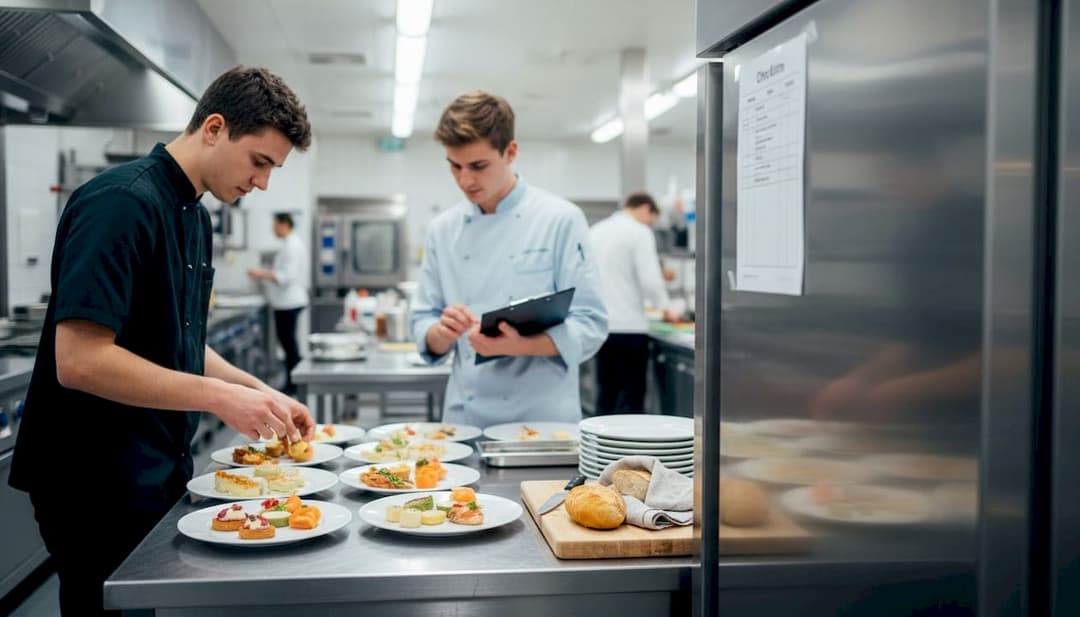
Logistics delays can affect even the best-laid plans. Traffic jams, accidents, or problems accessing the venue can delay setup. The 30 percent buffer in logistics time absorbs situations like these, but the team has to improvise when delays are extreme. This is where experience pays off: seasoned managers have backup plans for various scenarios.
Scaling recipes is an underestimated challenge. A dish that works perfectly for 10 people behaves differently at 200 portions. Cooking times change, temperatures need adjusting, and consistency can suffer. Professional caterers test scaled recipes in advance and document the adjustments for future events.
HACCP compliance is non-negotiable. The Hazard Analysis and Critical Control Points system mandates hygiene standards that must be followed when preparing, storing, and transporting food. Temperature checks, documentation, and regular training are mandatory. Violations can lead to fines or, in the worst case, food poisoning.
Other typical challenges:
- Unexpected changes in guest count shortly before the event
- Equipment failures, such as broken refrigeration units or stoves
- Weather-related problems at outdoor events
- Communication gaps between kitchen, service, and management
- Budget overruns caused by spontaneous client requests
Pro tip: Create an allergen and risk profile for every event. List all the critical points, from ingredient allergens to equipment dependencies to logistics risks. Develop a backup plan for each one. This proactive approach minimizes surprises and demonstrates professionalism to clients. Best practices in catering always include this kind of risk analysis.
Digitalization and software solutions for optimized catering management
Digital tools are revolutionizing catering management by automating manual processes and creating real-time transparency. Integrated systems like Univents, ROP IT, and easyBANKETT offer modular functions for quote creation, production planning, staff management, and logistics. This centralization reduces errors, saves time, and enables scaling without a proportional increase in administrative overhead.
Modern catering management software typically includes the following modules:
- Quote and contract management with templates, digital signatures, and automatic price calculation
- Production planning with automatically generated shopping lists and recipe scaling
- Staff scheduling with shift plans, availability requests, and time tracking
- Logistics and delivery coordination with route planning and status tracking
- Real-time dashboards giving an overview of every ongoing event, resource, and budget
- Financial management with invoicing, payment tracking, and cost analysis
Comparing popular systems reveals different areas of focus:
| System | Strengths | Target audience | Pricing model |
|---|---|---|---|
| Univents | Full integration, event hub, multi-language | Event managers, caterers, venues | Monthly, scalable |
| ROP IT | Focus on hospitality, POS integration | Restaurants with catering | License plus modules |
| easyBANKETT | Banquet specialization, room planning | Hotels, conference centers | License per workstation |
| Caterease | US market, extensive features | Large catering companies | Monthly, pricier |
Automated workflows are the main advantage of digital solutions. Here's an example: a client books an event online. The system automatically creates a quote based on the guest count and chosen menu, sends it for approval, generates the shopping list with buffers once confirmed, schedules staff based on historical data, and creates production lists for the kitchen. What used to take hours of manual work now happens in minutes.
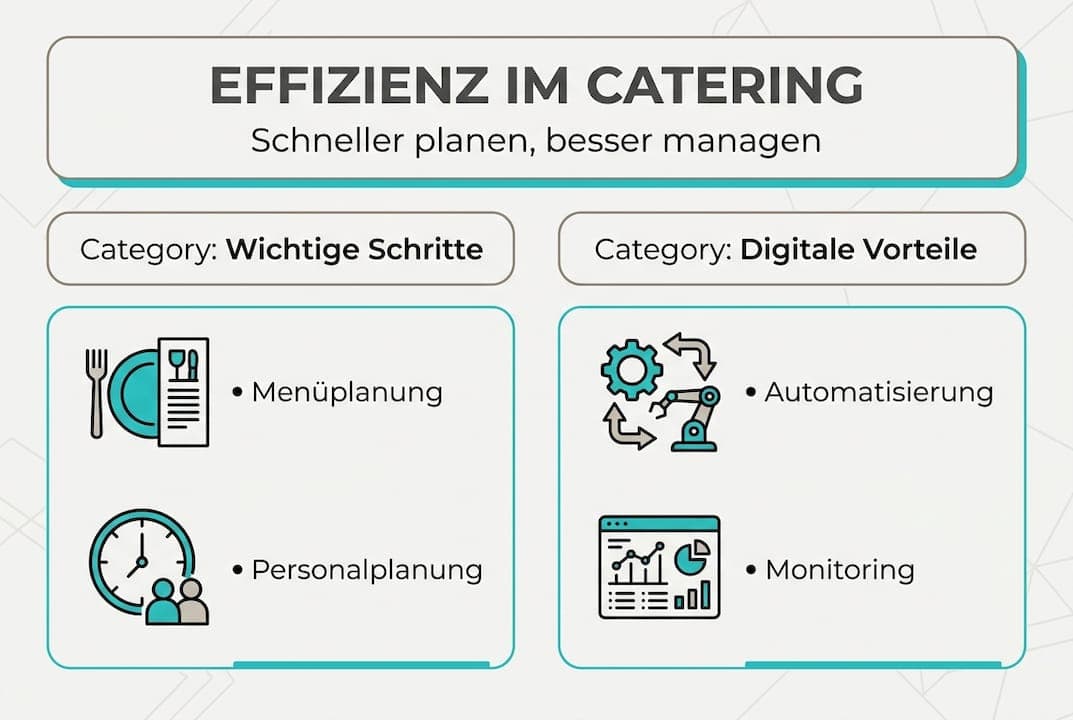
Central dashboards provide a real-time overview of every event. Managers can see at a glance which events are running today, where staff are missing, which ingredients need to be ordered, and whether budgets are being kept. This transparency enables proactive management instead of reactive crisis management. Automation significantly increases efficiency and reduces stress for everyone involved.
Implementation hurdles shouldn't be underestimated. Switching from manual processes to software requires training, patience, and often adjustments to existing ways of working. A gradual transition makes sense: start with one module, such as quote management, build up experience, and then expand into other areas. Staff need to be involved so they recognize the benefits and accept the system.
Typical benefits of digitalization:
- 40 to 60 percent time savings on administrative tasks
- 20 to 30 percent fewer errors through automation
- Better utilization of staff and resources
- Faster response to client inquiries
- Data-driven decisions instead of gut feeling
- Scalability without a proportional rise in administrative overhead
Digitalization in hospitality is no longer a trend — it's a necessity for competitive catering companies. Anyone still relying on Excel and paper in 2026 is losing time and clients to more digital competitors.
Using professional event management software from Univents
The challenges and methods described above show just how complex catering management is. Univents offers integrated event management software that makes exactly this complexity manageable. The platform brings every aspect together in one system, from the initial inquiry through planning and production to billing.
With Univents, you manage your events through central dashboards, automate quote creation and production lists, schedule staff efficiently, and keep an eye on budgets in real time. The event hub for communication and CRM makes sure everyone involved stays on the same page. The booking system with automation significantly reduces manual effort and gives you more time for what matters most: perfect events for your clients.
What is catering management? FAQ
What are the core tasks in catering management?
Catering management covers menu planning, resource allocation, staff management, logistics coordination, and budget control. It orchestrates every process from client contact through post-event follow-up, and its holistic perspective is what sets it apart from pure kitchen work.
How does software improve catering management?
Software automates administrative tasks like quote creation, shopping lists, and staff scheduling, saving 40 to 60 percent of the time. Real-time dashboards create transparency across every event, resource, and budget, enabling proactive rather than reactive management. Automation reduces errors by 20 to 30 percent.
What challenges are typical in catering management?
Typical challenges include complex dietary requirements such as allergens and vegan options, staffing shortages at large events, logistics delays, and recipe scaling. HACCP compliance and proactive risk management are essential for mastering these challenges.
Why are buffers important in resource planning?
Buffers of 10 to 15 percent on ingredients and 15 to 20 percent on staff guard against unforeseen situations like a jump in guest numbers or absences. For logistics, a 30 percent time buffer is recommended to compensate for traffic problems or setup complications. Without buffers, small deviations can jeopardize the entire event.
How does automation increase efficiency in catering?
Automation significantly reduces manual work in quote creation, production planning, and invoicing. Workflows run without human intervention, which minimizes errors and enables scaling. Catering companies can handle more events with the same administrative effort and respond faster to client inquiries.
What does real-time monitoring mean for events?
Real-time monitoring shows the status of the kitchen, service, staff, and logistics on a dashboard throughout the event. Managers spot bottlenecks immediately and can respond before problems escalate. This transparency improves service quality and significantly reduces stress for everyone involved.
Recommended reading
- Plan more efficiently, sell better: future trends for event and catering businesses
- Catering management systems: efficiency for event organizers
- Catering management 2026: digital processes & efficiency
- Catering management systems: efficiency for event organizers
See how Univents works specifically for your industry – with all features, examples and pricing at a glance.
Catering Software